Navigating North African Investment Treaties: A guide for East Asian investors (Korea and China)
-
Insight Article 04 August 2026 04 August 2026
-
Africa
-
Economic insights
-
Corporate
As global supply chains continue to diversify and East Asian investors seek new markets, production bases and infrastructure opportunities, North Africa has emerged as one of the most attractive investment destinations outside Asia.
The region sits at the crossroads of Africa, Europe and the Middle East, offering access to a rapidly growing consumer market, competitive labour costs, developing industrial infrastructure and proximity to major global trade routes. Chinese and South Korean investors have increasingly recognised these advantages and are becoming major participants in the region’s infrastructure, energy, manufacturing, distribution, logistics and technology sectors.
China has already established itself as Africa's largest trading partner meanwhile South Korean investors are increasingly exploring opportunities. The combination of industrial zones, export-oriented production hubs, renewable energy projects and large-scale infrastructure programs has transformed North Africa from a frontier market into a strategic investment destination. The combined annual average outflow of both countries sits at around USD 200 billion.1,2
In 2024, North Africa recorded over USD 51 billion in FDI inflows. While inflows moderated in 2025, regional FDI still stood at USD 22 billion.3 Egypt alone attracted approximately USD 15.5 billion in foreign direct investment in 2025, the highest level in Africa, supported by significant economic reforms, investor incentives and continued investment in priority sectors including logistics, renewable energy, information technology and manufacturing4.
Yet investment opportunities inevitably bring investment risks. Regulatory change, political shifts, contractual disputes, currency restrictions and expropriation concerns remain issues that sophisticated investors must carefully evaluate before committing capital. Particularly, recent years have seen increased governmental intervention across strategic sectors, including energy, infrastructure, telecommunications and natural resources.
For Chinese and South Korean investors deploying significant long-term investments into North Africa, legal protection mechanisms are therefore just as important as commercial opportunities.
This is where International Investment Agreements (IIAs) assume critical importance. Through a network of bilateral investment treaties ("BITs"), together with regional agreements such as the Organisation of Islamic Cooperation Investment Agreement ("OIC IIA") and the Unified Agreement for the Investment of Arab Capital in the Arab States ("Arab IIA"), investors may benefit from substantive protections that can significantly reduce investment risk and provide access to international arbitration against host States.
This article provides an overview of the investment treaty frameworks connecting South Korea and China with primary North African jurisdictions and analyses how East Asian investors can maximize their protections.
The legal framework: Bilateral and multilateral cover
There is no regional economic bloc for North Africa that offers a single unified investment code. Rather, North Africa features a layered web of BITs supplemented by regional conventions.
Both South Korea and China have established an extensive network of IIAs across the region:
- Bilateral Treaties (BITs): China and South Korea hold active, ratified BITs with all major North African economies (Egypt, Algeria, Morocco, and Tunisia).
- Multilateral & Regional Treaties: Investors structured through regional holding entities (e.g., UAE or GCC-based subsidiaries) may also gain access to regional Arab and Islamic investment treaties, such as the OIC IIA or the Arab IIA.
Which investors may benefit?
To claim protection under an IIA, an investor must satisfy the definition of a protected “investor” under the specific treaty terms.
South Korea BITs (e.g., Korea–Algeria BIT, Korea–Egypt BIT)
The definition of a protected "investor" under South Korea’s BIT network with North African host states requires satisfying explicit criteria for natural or juridical persons:
- Natural Persons: Any natural person possessing the nationality of South Korea (or the host Contracting Party) in accordance with its applicable domestic laws. (Under the older Korea–Tunisia BIT, the term is defined as "citizens" under domestic legislation).
- Juridical Persons: Any legal person or corporate entity incorporated, constituted, or established under the laws and regulations of South Korea (or the host state) and recognized as a juridical person. This encompasses public institutions, corporations, private companies, partnerships, foundations, firms, and organizations. The Korea–Tunisia BIT extends this definition to entities in which nationals hold a direct or indirect predominant interest.
China BITs (e.g., China–Egypt BIT, China–Morocco BIT)
China’s BIT network across North Africa defines the Investor as:
- Natural Persons: Individuals holding Chinese nationality (or host state nationality) under national law.
- Juridical & Economic Entities: Encompasses economic entities, legal persons, or companies incorporated or established in accordance with Chinese law. Modern treaties (e.g., China–Tunisia BIT) explicitly clarify that covered entities apply "irrespective of whether or not for profit and whether its liabilities are limited or not".
Which investments?
The definition of “investment” across both Korean and Chinese BITs with North African states generally adopts an open-ended asset-based approach.
Protected assets typically include:
- Movable and immovable property, alongside property rights (mortgages, liens, pledges).
- Shares, stocks, debentures, and equity participation in local enterprises.
- Claims to money or performance contracts having economic value.
- Intellectual Property Rights (patents, trademarks, industrial designs, technical processes, know-how).
- Concessions conferred by law or contract, including natural resource exploration and exploitation rights.
The OIC and Arab IIA generally adopt a wide definition of what constitutes an investment. Under the OIC IIA, an investment is the employment of capital with a view to achieve profit.5 A similar definition is adopted by the Arab IIA defining investment as the use or transfer of Arab capital in an economic or social field.6
Standards of protection
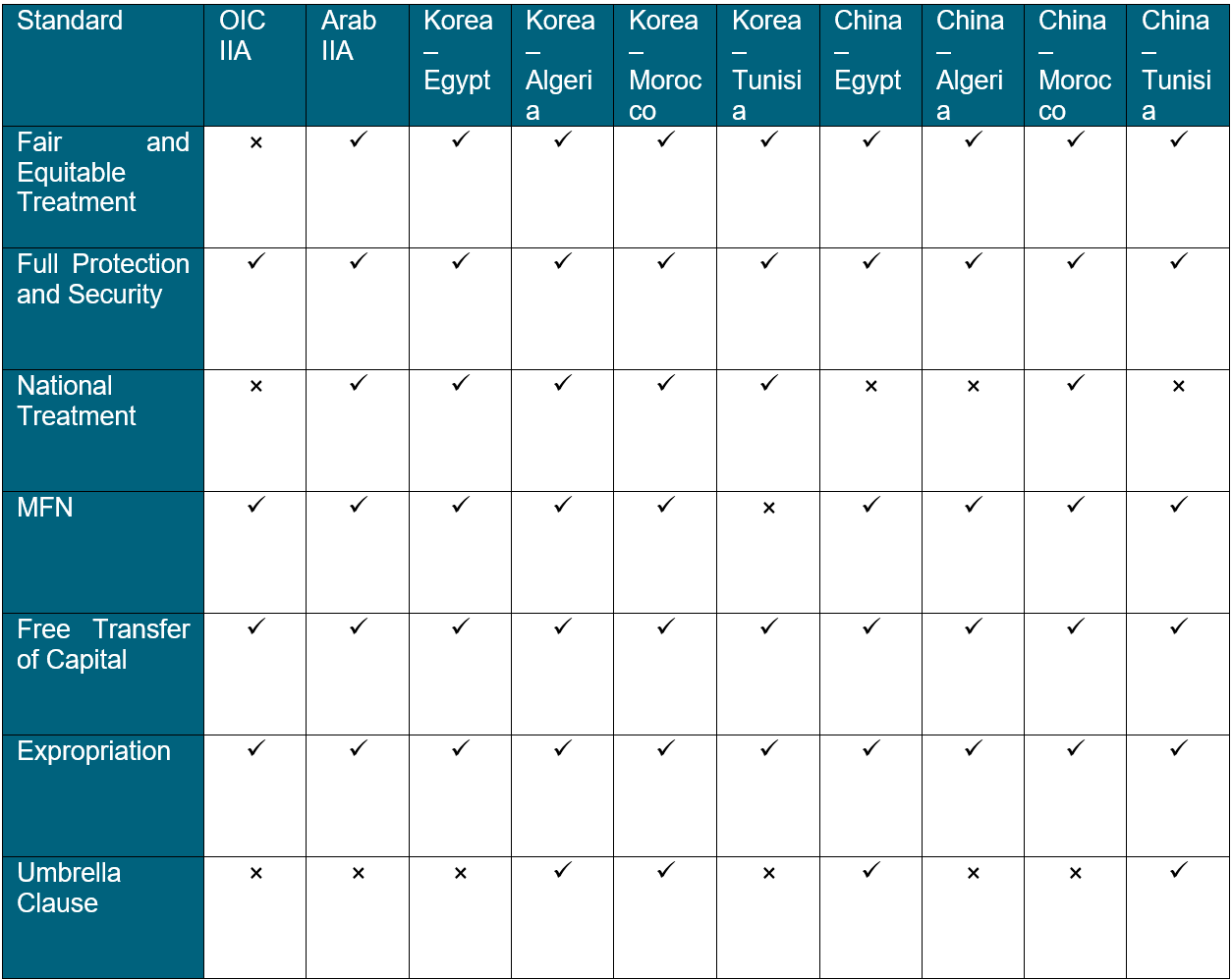
We have set out below a table with a brief overview of the standards of protection available under each of the IIAs.
Dispute resolution frameworks
Under Korean BITs with North Africa
The Korea–Algeria BIT and the Korea–Morocco BIT offer Korean investors a direct choice between submitting a dispute to the competent domestic court of the host State or filing for binding arbitration under ICSID (International Centre for Settlement of Investment Disputes). Notably, the Egypt–Korea BIT expands this choice further by allowing the investor to select between ICSID arbitration or UNCITRAL ad hoc arbitration. Unlike the later Korean BITs, the Korea-Tunisia BIT contains a standing consent to ICSID conciliation rather than a conventional investor-State arbitration mechanism. The host State irrevocably undertakes to submit disputes to the ICSID conciliation procedure and waives any requirement to exhaust local remedies.
Under the Egypt–Korea BIT, the investor's choice of arbitral forum is explicitly designated as final. Investors across all North African jurisdictions must carefully evaluate the procedural interaction between initiating domestic court proceedings and preserving their right to international arbitration to avoid premature forum selection.
Under Chinese BITs with North Africa
In contrast to Korea's generally broader acceptance of investor-State arbitration, the dispute resolution provisions contained in China's BITs with North African States vary depending on the generation and wording of the relevant treaty.
The China-Tunisia BIT provides the broadest investor-State dispute settlement mechanism among China's North African BITs. Following a six-month cooling-off period, investors may submit investment disputes either to the host State's competent courts or directly to ICSID arbitration. Once the investor has elected either forum, the choice is final and binding under the treaty's fork-in-the-road provision. The accompanying Protocol further requires Chinese investors to complete a domestic administrative review procedure before commencing arbitration, although that procedure may not exceed three months and does not require recourse to the domestic courts.
The China-Morocco BIT adopts a more restrictive approach. Investors may submit disputes to the host State's courts or to ICSID arbitration. However, the treaty contains standing consent to ICSID arbitration only for disputes concerning compensation arising from expropriation. Other investment disputes may only be submitted to ICSID with the consent of both the investor and the host State. The treaty similarly contains a fork-in-the-road mechanism, such that the investor's election between domestic courts and arbitration is final.
Conversely, the earlier China-Egypt BIT and China-Algeria BIT contain significantly narrower dispute settlement provisions. Under those treaties, recourse to international ad hoc arbitration is limited to disputes concerning the amount of compensation payable following an expropriation. Other substantive treaty claims must generally be pursued before the host State's domestic courts unless the parties separately agree to submit the dispute to arbitration
The four Chinese BITs across the region prescribe a mandatory 6-month amicable negotiation/cooling-off period following formal notification before arbitral proceedings can be commenced. Investors must carefully review whether initiating domestic litigation permanently forfeits their right to international arbitration under the applicable treaty's fork-in-the-road provisions.
Under the OIC IIA
Disputes under the OIC IIA can be resolved through the local courts or ad hoc arbitration. However, if an investor resorts to either of those, it will lose the right to recourse to the other method i.e., if an investor elects to resort to arbitration it cannot resort to the local court. There are no specific rules governing the arbitration, so the conduct of the arbitration will be left to the investor and the host state agreement. There is also no agreement on the seat and arbitrations under the OIC IIA were previously seated in several countries including the UK, Netherlands and France.
Under the Arab IIA
Investors have a wide selection of options to bring a claim under the Arab IIA. They can resort to domestic courts, the Arab Investment Court, or alternative dispute settlement mechanisms, including mediation, conciliation and arbitration. However, because the Arab Investment Court proceedings can be slow, investors under the Arab IIA predominantly elect ad hoc arbitration (e.g., under UNCITRAL rules). The arbitration rules are left to the parties to agree on. However, absent an agreement, the arbitration proceedings will be according to the UNCITRAL Rules. Claims under the Arab IIA were known to have been commonly seated in Cairo.
There is a fork in the road clause so if an investor chooses a specific mechanism to resolve its claim, it cannot resort to any other method.
Conclusion
North Africa is no longer merely an emerging destination for foreign capital. It has become a strategic investment corridor linking Asia, Africa and Europe, with significant opportunities for Chinese and South Korean investors in infrastructure, energy, manufacturing, logistics and technology.
However, as investment values increase, so does exposure to regulatory and political risk. Sophisticated investors should therefore approach investment treaty protection as a core element of investment planning rather than a remedial measure after a dispute arises.
The extensive network of Chinese and South Korean BITs across North Africa, supplemented by regional instruments such as the OIC IIA and the Arab IIA, offers investors powerful protections including protection against expropriation, fair treatment standards, guarantees relating to capital transfers and access (depending on the treaty) to international arbitration.
Investors who carefully structure their investments before entry into the market can significantly enhance both the protection of their assets and their ability to seek effective remedies if disputes arise.
1 China Belt and Road Initiative (BRI) Investment Report 2025 – Green Finance & Development Center
2 Press Releases
3 wir2026-regional_trends_africa_en.pdf
4 https://www.zawya.com/en/business/investment/egypt-tops-africa-with-15.5bln-in-2025-fdi-as- government-readies-new-investment-strategy-411404
5 Article (1) (5) of the OIC IIA.
6 Article (1) (7) of the Arab IIA.
End