Assurance et réassurance
Health and safety at work: what the HSE’s 2026 statistics mean for defendants and insurers
25 novembre 2026
Cliquez sur chaque termes pour accéder aux articles correspondants
Royaume-Uni et Europe
Défis humains
Assurance et réassurance
Reported silicosis cases remain relatively modest in Great Britain, but the growth in cases associated with engineered stone, a younger affected cohort and increasingly active HSE enforcement represents a significant change in the underlying risk profile. Defendants and insurers should prepare for greater claims activity while continuing to test diagnosis, exposure, breach and causation carefully.
In our previous update, Silicosis: An evolving risk, we considered whether increased awareness of respirable crystalline silica (RCS), particularly exposure arising from the fabrication of engineered stone, might translate into increased personal injury claims.
The latest available data does not demonstrate an Australian-style epidemic in Great Britain. However, it does provide clearer evidence of an emerging cohort of individuals affected by engineered stone. When combined with enhanced case surveillance, developing diagnostic techniques and active regulatory enforcement, the data justifies a more cautious approach by defendants, insurers and those underwriting silica-exposed risks.
The principal sources used by the HSE measure different things and should not be treated as a complete census of silicosis.
Industrial Injuries Disablement Benefit (IIDB) data record benefit assessments, while the Surveillance of Work-related and Occupational Respiratory Disease scheme within the Health and Occupation Research network - THOR (SWORD) - relies on reporting by participating respiratory physicians. Neither captures every diagnosed case.
The latest completed annual figures show that:
More recent surveillance reinforces that direction of travel. As at 3 September 2026, the “THOR dashboard” recorded 391 confirmed silicosis cases since 1996, including 58 attributed to engineered stone. It recorded 18 confirmed silicosis cases during 2026 to that point, 14 of which were associated with engineered stone. The reported mean age at diagnosis was 58 for silicosis generally, but 42 for engineered-stone silicosis.
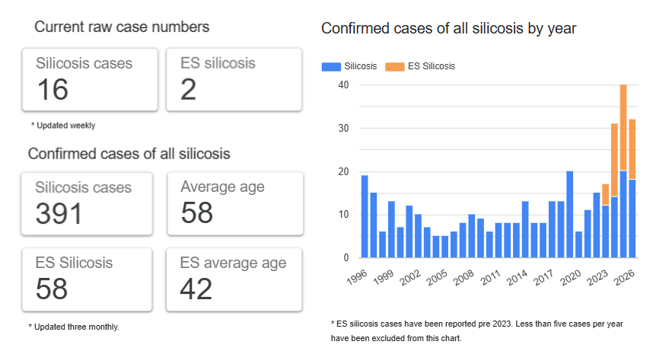
This does not mean that 58 engineered-stone claims will necessarily follow. Nor does it establish the incidence of disease among those working with engineered stone: the number of exposed workers is not known, so a reliable denominator is unavailable. Nevertheless, the combination of increasing numbers and a materially younger affected cohort is significant from a claims perspective.
The HSE’s update notes that both the annual statistics and the dashboard are likely to “substantially underestimate” the true incidence of silicosis.
SWORD is a voluntary reporting scheme. Its results may be influenced by the number of participating physicians, delayed or missed reports and the disruption caused by the coronavirus pandemic. Silicosis may also be asymptomatic in its early stages, has a potentially long latency and can be misdiagnosed as another condition, including sarcoidosis. The dashboard accordingly presents unadjusted reported cases rather than a population incidence rate.
Conversely, greater awareness may itself increase recorded numbers without proving that the underlying incidence has increased to the same extent. Specialist referrals, targeted health surveillance and improved identification of occupational history can all lead to cases being recognised which might previously have gone undiagnosed or been attributed to another disease.
Any conclusion premised upon this data therefore needs to be measured. The overall number of reported cases remains modest, but the profile of the risk is changing. Engineered stone now accounts for a substantial proportion of recently reported cases and is associated with disease in younger workers, sometimes following comparatively short periods of intense exposure.
The statistical trend must also be considered alongside the HSE's intervention in the engineered stone sector.
In May 2026, the HSE published its first COSHH guidance specifically for engineered stone and commenced a nationwide inspection programme involving more than 1,000 planned visits during 2026/27. The guidance effectively rules out dry cutting, grinding and polishing unless an employer can demonstrate controls that are at least as effective as water suppression.
The HSE's research found that dry fabrication typically produced RCS exposure five to ten times higher than equivalent wet methods. By the end of May 2026, inspectors had already served Prohibition Notices on four companies because of inadequate controls. The identified failings included deficient health surveillance, respiratory protective equipment, local exhaust ventilation and machinery guarding.
The guidance directs employers to use stone with the lowest practicable crystalline-silica content, control mist generated by water suppression, provide powered air-purifying respirators with an assigned protection factor of at least 20 where specified, review controls regularly, maintain appropriate cleaning arrangements and provide health surveillance where there is a reasonable likelihood of COPD or silicosis developing.
Importantly, the guidance is not new legislation or a formal statutory prohibition. Nevertheless, its publication and the accompanying enforcement campaign provide a much clearer statement of the standards the regulator expects today.
For historic claims, the 2026 guidance should not simply be applied retrospectively as if it defined the standard of care in earlier years. The relevant questions remain what the employer knew or ought reasonably to have known during the alleged exposure period and whether the precautions then taken were reasonable. For current and future exposures, however, departure from the published controls is likely to make a defence on breach substantially more difficult.
The combination of greater public awareness, more targeted health surveillance and enhanced regulatory scrutiny is likely to identify additional cases, including disease at an earlier stage. That may increase the volume of enquiries and claims notifications, particularly in the engineered-stone sector, although a reported diagnosis will not of itself establish exposure, breach or legal causation.
Insurers may wish to consider the following practical steps in managing their risk profiles:
The latest data does not establish that Great Britain is experiencing an epidemic comparable to that reported in Australia. Overall case numbers remain relatively low and the limitations of the available sources prevent firm conclusions about national incidence.
However, it would now be equally unsafe to rely on historically modest claim volumes. Engineered stone represents an increasingly identifiable part of the reported caseload; affected workers are younger; surveillance is becoming more accessible; and the HSE has moved decisively into industry-specific guidance, inspection and enforcement.
For defendants and insurers, the appropriate response is neither alarm nor complacency. The priority should be careful risk selection, preservation of evidence and early, expert-led investigation of diagnosis, exposure, breach and causation.
Fin